
Добавь сайт в закладки нажми CTRL+D
Spark Space secured new funding for a rocket that will significantly surpass Rocket Lab’s Electron in payload capacity
The Chinese firm Spark Space, established two years ago, has attracted additional investments to develop the Jinhua-1 rocket, also known as Evolution-1. The company claims to be creating the world’s largest rocket powered by electric pump engines—a design that has only been successfully implemented on the much smaller Electron rocket from the American company Rocket Lab.
This latest funding round followed the successful initial fire tests of the Lieyan-2 engine using kerosene and liquid oxygen. According to the company, these tests confirmed the design’s functionality, ignition stability, and the engine’s performance under vibrations and pressure variations during operation. The duration of the tests has not been disclosed. The next steps will include reliability checks for the engine, testing of the first stage’s propulsion system, and the complete assembly of the rocket.
The Jinhua-1 is a two-stage expendable rocket measuring 27.5 meters in length and 2.25 meters in diameter. The first stage will be equipped with nine Lieyan-2 engines, while the second stage will have one engine optimized for vacuum operation. The total thrust at launch will reach 90 tons.
According to the specified characteristics, the rocket will be capable of delivering up to 1.5 tons of payload to low Earth orbit and up to one ton to sun-synchronous orbit. In comparison, the Electron can carry approximately 300 kilograms to low orbit.
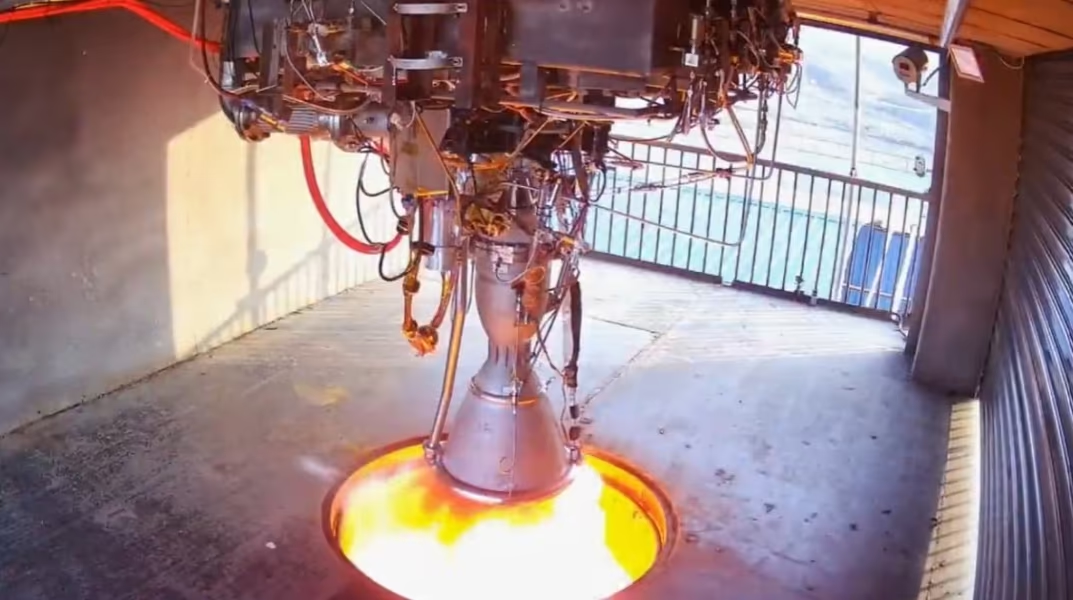
The electric pump design is considered simpler and lighter, as it eliminates the need for complex turbopumps and gas generators. However, it also has drawbacks, including limited specific impulse and the requirement for large batteries. This is why Rocket Lab opted for a traditional gas-generator cycle for its new medium-class rocket, Neutron.
Spark Space claims that each Lieyan-2 engine produces a thrust of 10 tons, whereas the thrust of a single Rutherford engine on the Electron rocket is about 2.4 tons at sea level. If the claimed specifications are verified, the Jinhua-1 will become the largest rocket utilizing electric pumps.
The company has already secured several funding rounds. In early June, Spark Space raised nearly 100 million yuan in a Pre-A funding round, and on June 18, it announced additional funding in the tens of millions of yuan. Previously, the startup also received seed investments from private funds and entities linked to the Hefei government.
Production and testing are being conducted at a facility covering over 10,000 square meters in the national high-tech zone of Hefei. The company is also expanding its infrastructure by an additional 20,000 square meters. According to the Chinese publication 36Kr, the team includes specialists who previously worked at the China Aerospace Science and Technology Corporation (CASC), the China Aerospace Science and Industry Corporation (CASIC), and the Chinese Academy of Sciences.
Spark Space aims to offer the Jinhua-1 as a cost-effective rocket for rapid launches and replenishing satellite constellations. The company has set an ambitious goal to launch the rocket into orbit by 2027, but will have to compete in a crowded Chinese market, where rockets such as Ceres-1 from Galactic Energy, Kinetica-1 from CAS Space, and Kuaizhou-1A from Expace are already flying regularly. If the project succeeds, China will gain another player in the rapidly growing segment of commercial launches.
ИсточникПоделись видео: